4 Types of Useless Meetings That Should Not Exist
There are species of meetings that have no natural predators. It does not need a purpose to survive; it does not need an agenda; it does not need to produce a decision, an outcome, or even a coherent sentence.
It just needs a calendar with available space, and in most organisations, there is always space.
Your organisation handbook won’t tell you this, but take it with a pinch of salt. Unproductive meetings are not an accident. They are the default.
The calendar does not ask whether a meeting should exist. It only asks when, and because nobody built a system to answer the first question, the second question gets answered 12 times a day, 5 days a week, until everyone is booked, busy, and still somehow behind the production schedule.
71% of meetings are considered unproductive by the people sitting in them. And you begin to wonder who scheduled the meetings in the first place? That’s a question for the century!
Take a look at the four types responsible for most of the damage. You have attended all of them. You have probably hosted some. And after reading this, you will never be able to unsee them on your calendar again.
If you don’t have a change of mind, then you are probably part of the problem responsible for the waste of time and resources in your organisation.
Your Calendar Has a Pest Problem- Useless Meetings
Not all unnecessary meetings were born useless. Some had a reason once. Some were good ideas that nobody cancelled when the idea expired. Some were never necessary at all, but got dressed up in professional language and sent as a calendar invite before anyone thought to ask why.
The result is the same in every case: a calendar full of meetings that feel like work and a team with no time to do any real work. Get your spray can ready to kill those pest-like Meetings.
First Type of Useless Meeting- The Catch-Up Sync
"Hey, let's find some time to connect."
This usually means “I have something to tell you, but I do not want to write it down. Or I am not sure what I want to say, so I will figure it out in real time. Or I just miss you, and this felt more professional than calling.”
That sentence has launched more unproductive meetings than any other in the history of the modern workplace. It is also the most socially acceptable form of time theft.
The catch-up sync has no agenda. It does not need one; the agenda is catching up. It has no decision to make, no output to produce, no reason for thirty minutes of two to five people's calendars to be blocked when a two-line message would have done the same job in eleven seconds.
And yet there it is on Tuesday at 2 pm.
It is not wrong to catch up; it’s a real human need, not necessarily a professional need, and the format of expressing that need is wrong, especially in a workplace or during working hours.
A Slack message. A voice note. A two-line email.
Pick one. Send it and use the thirty minutes for something productive.

Second Type of Useless Meeting- The Information Download
This one is more dangerous than the catch-up sync because it looks legit.
There is a presenter, slides, and a shared screen. Multiple people are in the room, their cameras on and their expressions carefully arranged to suggest engagement.
From the outside, it looks exactly like a meeting should look.
But it is not.
The information broadcast meeting is one person talking and everyone else listening. No decisions are being made. No collaboration is happening. The information could have been read. It is being narrated instead. Because somebody, somewhere, decided that sharing a document was less important than being seen sharing it.
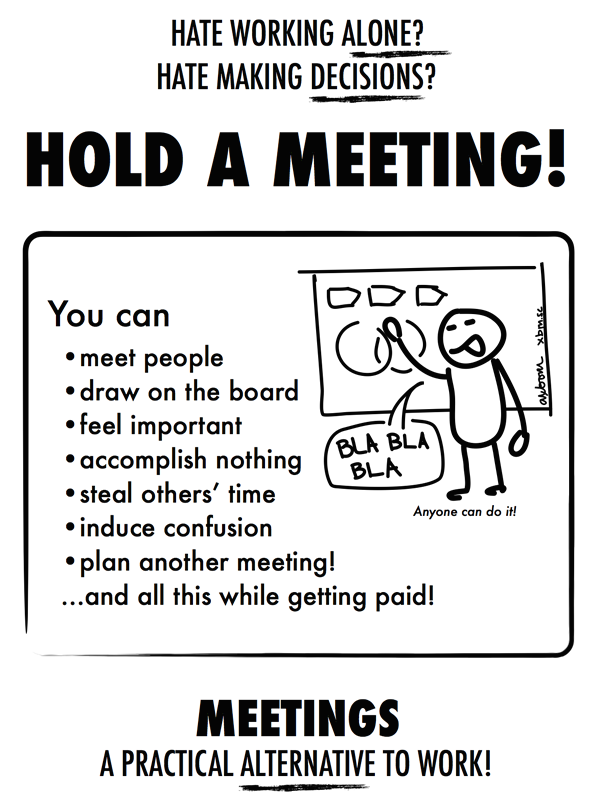
For the umpteenth time, one person presenting to ten people for an hour is not one hour spent. It is ten hours of company output quietly dissolving into a slide deck that will never be opened again.
Shopify's COO, Kaz Nejatian, said it plainly: "No one at Shopify would expense a $500 dinner. But lots and lots of people spend way more than that in meetings without ever making a decision."
He is right, and the information download is where most of that money goes.
Jeff Bezos understood this before most leaders were willing to admit it. His solution was thirty minutes of silent reading before any discussion began. Because reading is faster than listening. It is more precise. It puts everyone in the room at the same depth before anyone is allowed to perform, having got there.
The information can be documented. If it can be documented, the meeting has already failed its own premise. Presentations are not meetings; send the deck, record the walkthrough, and reserve the room for questions only.
Third Type of Useless Meeting- The Recurring Meeting That Outlived Its Purpose.

Every zombie meeting has an origin story.
There was a real problem; someone called a meeting, and the meeting was useful and well utilised, so it became a good idea to set it as recurring. Now, it's just ten people using the first 10 minutes to ask about their Cats and dogs. Then the next 10 minutes are spent asking the greatest question: "Can you see my screen?"
This is how the recurring meeting with no purpose comes to be. Not through bad intentions. Through the calendar's single greatest design flaw: the repeat function has no expiry date.
And so the meeting keeps showing up.
Every Monday at 10 am.
Every other Thursday.
Every first Friday of the month.
Long after the project it was built for has shipped, stalled, or been quietly shelved. Long after half the original attendees have left the company. Long after anyone in the room can remember why the room was first called together.
Shopify did this maths in January 2023 and decided they had seen enough. They cancelled all recurring meetings with three or more people and instituted no-meeting Wednesdays, two moves that cut 12,000 events, or 36 years of meeting time, from their calendars. An average 30-minute meeting costs between $700 and $1,600 once salaries are factored in.
Cancelling those 12,000 events saved an estimated $8.4 million.
From one decision: to stop repeating a question nobody was asking
"What decision did this meeting produce last month?"
No answer? Cancel it, simple and Short!
Recurring does not mean necessary. It means nobody cancelled it yet.
Fourth Type of Useless Meeting- Pre-Meeting Meeting
We have arrived at the final specimen of things that should not exist.
The most absurd and diabolical creature in the corporate calendar ecosystem. A meeting is scheduled to prepare for another meeting.

Someone is nervous about an upcoming session. Whether the agenda is clear or not, the only or major reason for another meeting is that the stakeholders are unpredictable. The decision-maker might ask something nobody has prepared for. So someone does the only logical thing.
They call another meeting to rehearse the original meeting.
The pre-meeting sync is never a preparation strategy. It is a diagnostic to check how intact the agenda of the main meeting is. And that suggests the original meeting has a hidden or ulterior agenda, no named decision-maker, and no psychological safety for people to bring real, unscripted opinions.
The pre-meeting is not fixing the problem; it is just proof that the problem exists.
If your team needs a meeting to prepare for a meeting, one of two things is true.
The original meeting is broken somewhere and should be redesigned, or it should not exist at all; the pre-meeting is your subconscious trying to tell you this.
Either way, the solution is not another calendar invite.
Cancel the pre-meeting. If the meeting still needs to exist, fix it; otherwise, schedule it once with a clear agenda, aligned stakeholders and respect/psychological safety for all participants. Not twice with two vague ones.
The Pattern no one is recognising
Read back through all four.
None of them was created maliciously. They all had good intentions to solve a problem. Nobody sat down and thought: I will design a meeting that wastes everyone's time and teaches the organisation to confuse activity with output.
The meetings exist because the calendar is permissive by default.
Anything gets on it, because nothing asks whether it should. This says a lot about an organisation's governance problem. Operators and senior leaders should be very wary of falling into the trap of default meetings because the organisation is large.
As much as one-third of all meetings may be completely unnecessary, according to research from Otter.ai and cutting those meetings at companies with more than 100 employees could save firms more than $2 million a year.
One third of everything on the calendar should go before a single process changes. Before a single person is retrained. Just by asking, before the invite goes out, whether the meeting needs to exist.
Before any meeting gets scheduled
One question. What decision will this produce that cannot be made any other way?
If the answer is nothing, it is a catch-up sync.
If the answer is information, it is an information download that should have been a document.
If nobody can remember why it started, it is a zombie recurring meeting that should have been cancelled two quarters ago.
If the answer is "to prepare for another meeting", you already know what it is.
It is not a complicated meeting; you just need the discipline and structure to consistently question its efficacy and efficiency. Most organisations never build that discipline because the calendar never demanded it.
You have to be intentional about structuring meetings and preserving the time of your employees and senior leaders.


